A practical proposal workflow for freelancers: from messy brief to structured packages and a ready-to-send PDF without lost context.
If I had to summarize it, proposals almost never break at the final PDF stage. They break earlier, when the brief lives in chat, the scope lives in your head, relevant case studies have to be remembered manually, and packages are assembled by copying fragments from old documents.
So the main question is not whether AI can “write a pretty proposal.” The real question is whether there is a proper workflow around the proposal, where client context, services, packages, risks, and the next step live inside one logic instead of six browser tabs.
This article is part of the Freelance OS series — a CRM system I am building for my own freelance workflow. Here I focus specifically on the proposal part: what should be pulled automatically before the PDF even exists, what still needs manual review before sending, and why proposal workflow has to be part of CRM logic, not a separate magic button.
Where commercial proposals really get stuck
For an experienced freelancer, the bottleneck is rarely the document itself. The problem usually starts earlier, at the moment you need to turn a messy client request into a structured scope. Especially when the client does not arrive with a finished technical brief and says something like “we need help with ads, analytics, and maybe the site too.”
At that point you have to align at least four things manually: what the client is actually struggling with, what level of work is realistic to offer, what package format will be easy to understand, and what the client should do after reading the document. If every proposal starts from zero, it quickly becomes a point of overload.
What should be pulled automatically before the PDF stage
In a strong proposal workflow, automation does not write “everything instead of you.” It removes manual noise before the final decision.
- Client context: who this is, which acquisition channel they came from, which pain is already visible in the brief, and which questions are still open.
- Relevant proof: not every case study you ever had, only the ones that actually strengthen the argument for this type of request. Examples of these cases are on the cases page.
- Basic service patterns: common package structures for PPC, analytics, SEO, or consulting work so you do not rebuild the same logic from scratch every time. The full list of services that go into packages is on the services page.
- Document structure: scope, deliverables, packages, next step, and CTA, so the proposal does not read like a random stack of paragraphs.
This is where real attention savings begin. Not in “press a button and it is done,” but in the fact that you are no longer starting from an empty page.
What a strong flow from brief to PDF looks like
1. The brief becomes structured input
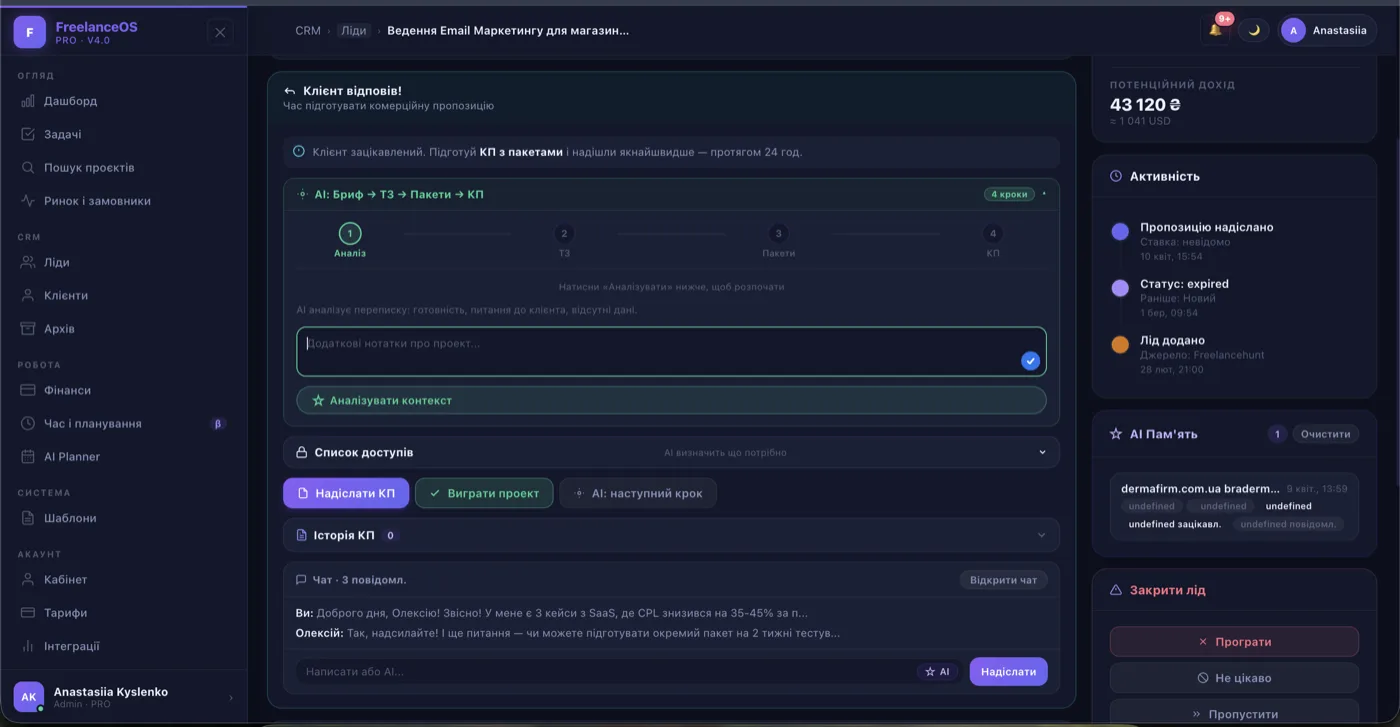
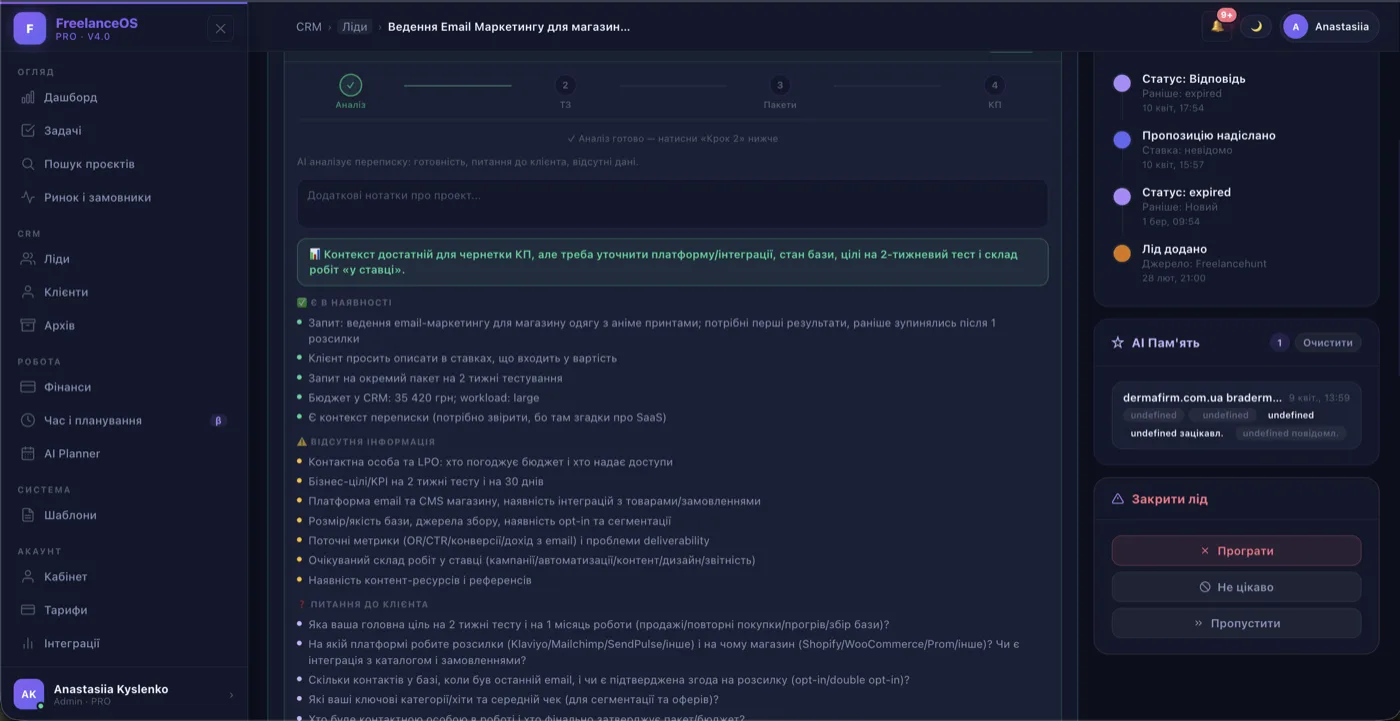
The request should not live only in chat. You need a fixed view of the pain, expectations, open questions, and basic constraints around budget or timing. Without that, the proposal is built on assumptions.
2. The system pulls relevant context
The biggest value here is that the freelancer does not manually search old case studies, wording, and service blocks. In Freelance OS this happens automatically: the system reads the request type, extracts matching service patterns, and shows only the elements that fit this specific lead. You see already filtered, structured material — not raw chaos.
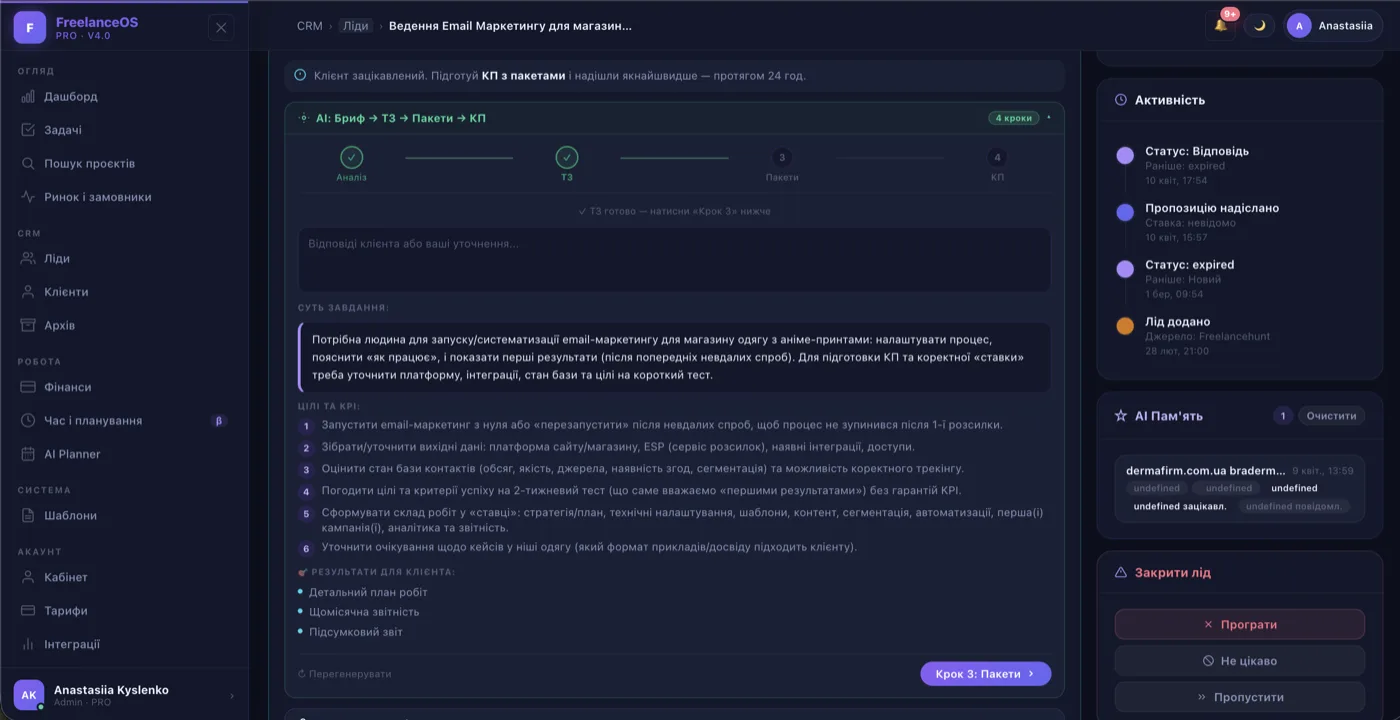
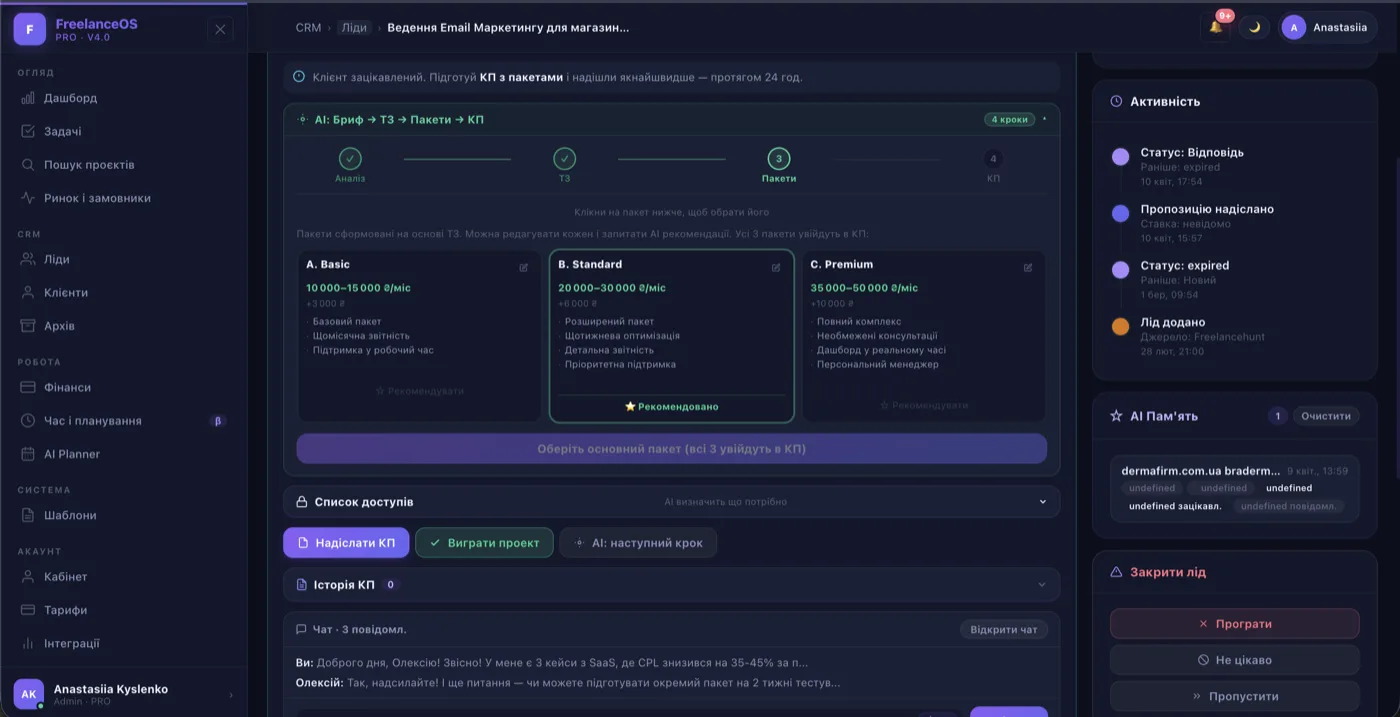
3. Scope turns into clear packages
Not to manipulate price, but to create clarity. It is much easier for a client to choose between two or three cooperation frames than to decode one long monolithic list of tasks with no structure.
4. The PDF becomes the final container, not the main problem
When the previous steps are assembled correctly, the PDF no longer has to rescue weak sales thinking. It simply packages a strong logic into a readable document that is easy to discuss and easy to send.
What it looks like inside Freelance OS
Four steps of the workflow in the real interface — from the first signal to proposal packages.
What still needs manual review before sending
This is exactly where it is easy to fall into the AI illusion. Even if the system does a good job collecting context and shaping packages, the final proposal should never go out on autopilot.
- whether the scope is too broad for the stated budget;
- whether the document promises more than can realistically be delivered;
- whether the tone is right: strict and structured or more consultative;
- whether the document contains one clear next step instead of five different possible reactions.
The value of the workflow is that the human spends attention on these high-value checks, not on manually collecting context from different places.
When this workflow creates the biggest impact
It works best when proposals are not a rare one-off event, but a repeatable sales stage in your business. If you regularly run discovery, estimate scope, prepare packages, and do follow-up, the manual mode starts eating a disproportionate amount of time exactly between lead and agreement.
If proposals happen rarely and are almost always identical, the effect will be smaller. But for a freelancer who is selling, delivering, and building pipeline at the same time, a strong proposal workflow removes one of the most expensive forms of attention loss.
A strong proposal starts with decision logic, not a template
A freelancer does not need another pretty PDF generator. They need a system where the brief, client context, packages, manual review, and final document are connected. That is when the proposal stops being creative improvisation and becomes a repeatably strong sales step.
In the Freelance OS series, this is the logical next step after AI scoring marketplace leads: not only finding a strong lead, but turning it quickly into a structured proposal without manual copy-paste or lost context.



Comments
Discuss on Telegram