A practical look at how Freelance OS filters noisy marketplace leads into a clearer warm queue through stack fit, budget sanity, and manual review.
If I had to put it simply, AI scoring in Freelance OS is not there to “choose the client for you.” It is there to do something else: remove the first layer of noise from the marketplace feed, separate strong signals from weak ones, and build a shortlist worth thinking about manually.
For a freelance digital marketer, the biggest loss does not happen when you fail to write a proposal. It happens earlier, when a strong project gets buried between bad briefs, tiny budgets, random “do everything turnkey” requests, and ten open tabs you are somehow supposed to keep in your head.
In this article I will show what AI scoring should actually evaluate, what needs to be visible in a warm queue, where AI should stop and the human should decide, and who this workflow already creates real value for.
What AI scoring actually does in a marketplace workflow
A solid scoring module should not just stick a “good / bad project” label on a lead. It should help you decide the next action. In practice that means four things:
- separate relevant requests from obvious noise without manually reading the whole feed;
- show why a specific lead moved up: stack fit, budget, brief quality, and fit with your current workload;
- build a warm queue where you can clearly see who deserves a reply today and what should be delayed or filtered out;
- leave the final decision to the freelancer instead of to a “magic score.”
That is why AI scoring for freelancers has to be part of CRM logic, not just a colorful lead list.
Why the marketplace feed breaks at the level of attention
When you have one client and plenty of free time, you can read almost every new project manually. Once you have 3+ active clients, delivery, follow-up, and proposal work, that strategy stops working. You start evaluating requests in fragments between other tasks, and the market starts setting priorities for you instead of the other way around.
That is when the usual mistakes appear. You open what looks urgent, not what is actually profitable. You miss a strong match because the brief was written poorly. You answer a mediocre lead because it is easier to read than a promising but messy request. Time gets lost not because you sell badly, but because you filter poorly.
So the bottleneck is not the lack of projects. The bottleneck is that without a filtering layer, even a good acquisition channel quickly turns into manual noise.
Which signals scoring should weigh first
1. Stack fit and task type
If you work in PPC, analytics, SEO, B2B, or e-commerce marketing, the system has to tell the difference between a direct match and a nearby request that only looks relevant on the surface but actually pulls you into a vague scope. For freelancers this is critical: poor fit rarely becomes worth it just because the project is new.
2. Budget versus the real scope
The same budget can be fine for an audit and toxic for a long execution project. That is why scoring cannot look at the amount in isolation. It has to read the relationship between what the client is asking for, how much they want to pay, and what kind of contract this is likely to become. This is where red flags matter more than the number itself.
3. Brief quality
A good brief does not guarantee a good client, but it usually means less wasted time on clarification, fewer blurred expectations, and a higher chance that the proposal will not need three rewrites. For scoring this is not decorative. It is a signal of future complexity.
4. Your current pipeline context
Even a strong lead should not always become a priority. If your week is already full, you have a pending proposal, and several stronger leads in progress, a new project may deserve “return later” instead of a green light. Without this connection to planner and CRM, any scoring layer stays half-blind.
What needs to be visible in the warm queue
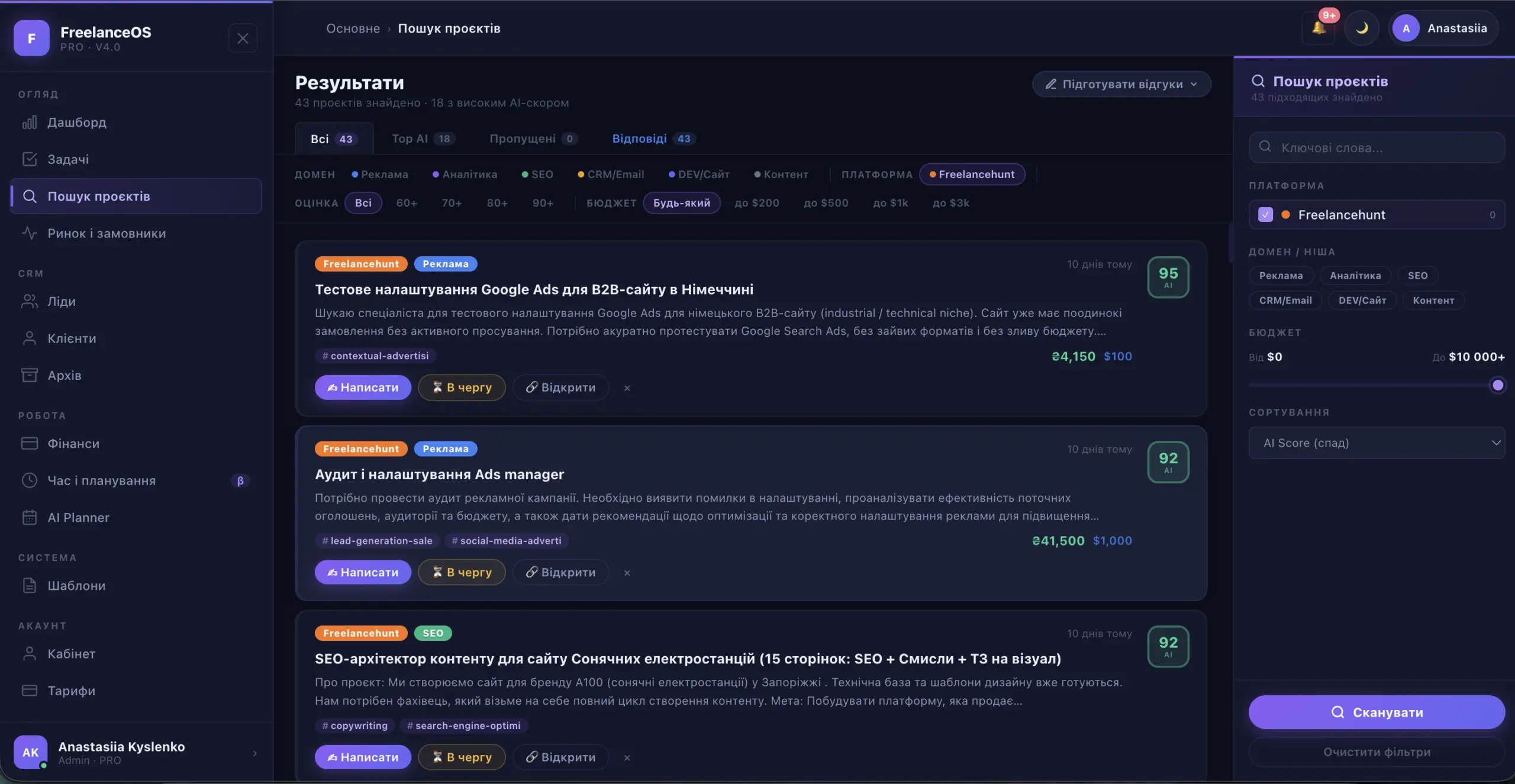
A score by itself does not help much if it still leaves you asking “so what now?” That is why a strong market radar should show not only rank, but working context for each lead.
- why the lead moved up: stack match, healthy budget-to-scope fit, and a decent brief;
- which red flags are already visible: vague request, weak budget, suspiciously wide scope;
- what the recommended action is: reply today, keep in shortlist, return later, or reject;
- whether the new lead conflicts with your current workload.
That is the kind of screen that gives product-led proof. Not “here is a task list,” but a visible reason for priority and a visible next step.
Where AI should stop and the human should decide
The worst thing this kind of product can do is pretend AI can press “take / do not take” instead of the freelancer. That is not true, and it is a bad product promise.
The final decision is still human. The freelancer decides whether they actually want this niche, whether the client tone feels right, whether there are toxic signals a formal system cannot see, and whether the contract supports their revenue strategy right now.
Strong scoring does not remove that decision. It simply makes sure you make it on a cleaned shortlist, not on a raw chaotic feed.
Who this workflow fits and who it does not
The biggest value shows up for a freelance digital marketer who treats the marketplace as a live acquisition channel, already has 3+ active clients, and cannot afford to review the whole feed manually every time.
If you take one new project a month and do not live inside a constant stream of requests, this workflow will be nice but not critical. But if the marketplace regularly brings you new potential deals, without a scoring layer you quickly return to the mode of “reply to whatever caught my eye first.”
Scoring is not automation for the sake of automation
The point of this module is not to “let AI do something.” The point is to stop a freelancer’s best attention from being wasted on a weak filter. If the system helps you spot strong lead signals faster, remove noise, and build a warm queue for the right response, it is already doing its job.
The logical next step after this kind of filtering is not just to find a strong lead, but to move it quickly into a solid proposal flow without manual copy-paste or lost context. That is exactly the next layer in the Freelance OS series.




Comments
Discuss on Telegram