 +180%
+180%
Email quest series: reactivated 28% users
A SaaS platform for freelancers: how a gamified email flow brought inactive users back and generated +$34K MRR
🎮
+$34K
MRR in 2 months
48%
open rate
28%
reactivation
Who this is for
This case study is for you if...
💻
SaaS with a high churn rate
You run a SaaS or subscription product with a large base of inactive users
📉
Email open rate below 15%
Users sign up and disappear after two to four weeks
📧
A base of 10K+ inactive users
Typical "We miss you" emails get ignored and open rate stays below 15%
🔄
Standard reactivation emails are no longer working
MRR is not growing because new users do not offset churn
See yourself in this? Keep reading: this case study shows the solution.
Context
About the project
A SaaS platform for freelancers with a base of 45K+ users
A SaaS platform for freelancers with a base of 45K+ users. Core markets: English-speaking and German-speaking audiences.
🔥
Challenge
60% of users became inactive within 30 days after signup. Email open rate had dropped to 12%. Standard reactivation emails no longer worked, because users ignored predictable "We miss you" messages.
🎯
Goals
01
Reactivate inactive users with a less predictable format
02
Raise email open rate from 12% to 30%+
03
Increase MRR by bringing dormant accounts back
Why this is hard
What can go wrong here
And why most contractors get it wrong
Standard reactivation emails get ignored
Users have already seen dozens of "We miss you" emails from other tools. Those emails feel like spam, open rates collapse to 5-8%, and the sending domain starts losing reputation.
How I solved it:
Quest mechanics with a progress bar, badges, and bonus unlocks so the series feels like a game instead of another reminder
One email is never enough
A single reactivation email works for only a small part of the base. Everyone else needs a sequence of touches, but a series without increasing value just becomes noise.
How I solved it:
A seven-day quest with progressive disclosure where each email unlocks a new feature
Inactive users are not one segment
A user who churned after one day is not the same as someone with three months of product history. Treat them the same and you get weak conversion and higher unsubscribe rate.
How I solved it:
RFM-based segmentation of inactive users, with different quest paths based on their previous engagement
Process
What was done
STEP 01
Cohort analysis and segmentation
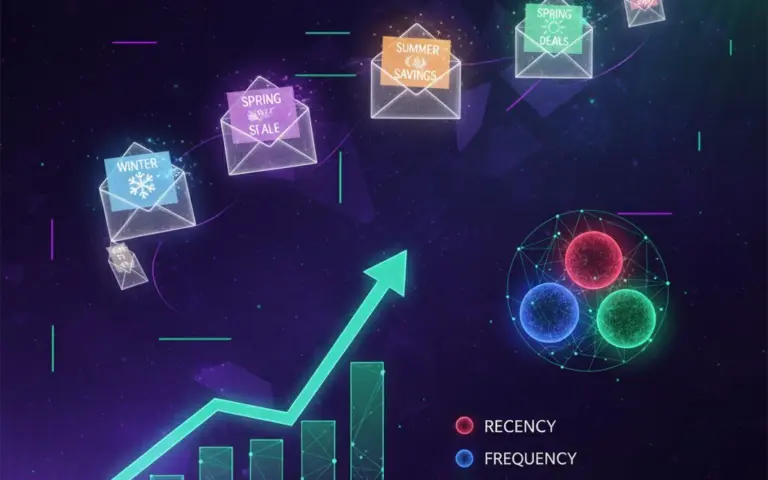
I ran RFM analysis on the user base, identified churn patterns, and segmented inactive users by how engaged they were before dropping off.
STEP 02
Quest mechanics design
I designed a seven-day quest with gamification elements: progress bar, badges for task completion, and bonus features unlocked as users moved forward.
STEP 03
Personalization and content
Each email used dynamic content based on previous user behavior. Progressive disclosure meant every message revealed a new product feature instead of repeating the same pitch.
STEP 04
A/B testing and rollout
I tested subject lines, send times, and CTAs while rolling the campaign out in stages: 10%, then 50%, then 100% of inactive users.
My approach
What I did differently
1
A quest instead of a standard email series
Instead of another "We miss you" flow, I built a seven-day quest with a progress bar, badges, and bonus feature unlocks. Users came back because the experience felt interesting, not pushy.
2
Cohort analysis before launch
I started with RFM analysis to map churn patterns and segment inactive users by prior engagement. The content was dynamic, so each user got a quest shaped by their previous behavior.
3
Gradual rollout with A/B testing
I did not send the flow to the full base immediately. The rollout moved from 10% to 50% to 100%, while I tested subject lines, send times, and CTAs at each stage. That is how the open rate reached 48%.
Results
Numbers that speak for themselves
48%
Open rate
28%
User reactivation
+$34K
MRR in 2 months
Transformation
Before and after
Open rate
12%
48%
Quest mechanics + personalization
Reactivation
Around 2-3% with standard emails
28%
Gamified quest flow
MRR
Flat
+$34K
Dormant accounts reactivated
Approach
"We miss you"
7-day quest
Badges, progress bar, unlocks
What this means for the business
+$34K
MRR added in 2 months of reactivation
28%
of inactive users returned to the platform
Gamification turned reactivation from the dullest part of email marketing into a channel that added $34K MRR.
Free resource
Template: email quest series for reactivation
A ready-made structure for a seven-day gamified quest: subject lines, content plan, points logic, and badge mechanics. Adapt it to your product in a day.
- PDF with the full seven-email structure
- Subject line examples behind a 48% open rate
- No signup, no spam
PDF
Email Quest Reactivation Template
Case services
Request similar work
Questions
FAQ
How does gamification help with email reactivation?
Gamification such as a progress bar, badges, and bonus unlocks turns email from a nagging reminder into an interactive experience. In this case, the quest mechanic raised open rate from 12% to 48% and reactivated 28% of inactive users.
What is considered a good open rate for reactivation emails?
A typical reactivation open rate is around 10-15%. In this case, the quest series reached 48% because it combined personalization, less predictable subject lines, and gamification. The key was standing out from the stream of standard "We miss you" emails.
How do you bring inactive SaaS users back without discounts?
Use a gamified quest instead of a discount push: a seven-email flow where each message unlocks a new feature. Users return for progress and bonuses, not because you slash price. In this case, that created +$34K MRR with no discounting at all.
More case studies
Related projects

Ready for growth?
Let's discuss your project and find the solution that works for your business.